
We marked Black History Month 2025 with our first ‘How to be a Journalist’ podcast mini-series.
Across four special episodes in October, host Plamedi Mbungu wanted to highlight challenges, opportunities and pathways into journalism for aspiring Black journalists.
Plamedi wanted to celebrate trailblazers who have carved space in our industry by pushing for more inclusion, representation and accountability in journalism.
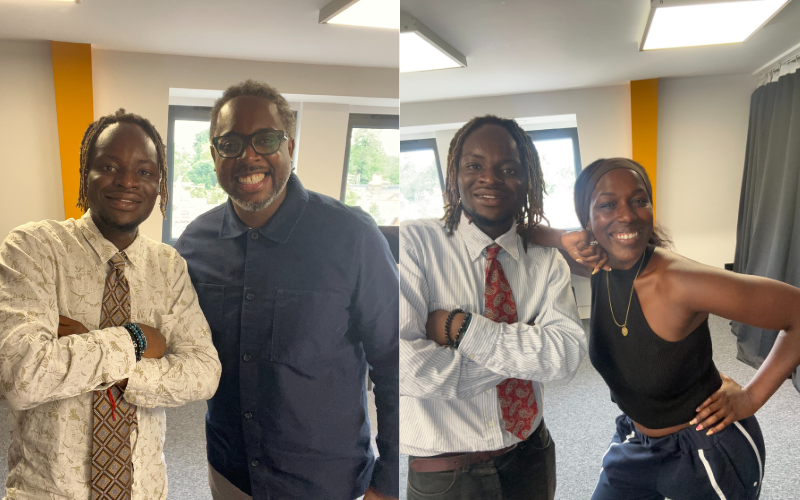
Plamedi interviewed award-winning BBC producer Hannah Àjàlá, Channel 4 News sports journalist and podcast host Jordan Jarrett-Bryan, Global Citizen content creator and The Flo Journal founder Fadeke Banjo and Radio News Hub broadcast journalist Grace McIntosh.
Here, journalism outreach coordinator Grace Crowley spoke to podcast host Plamedi about his inspiration behind the mini-series, stand-out moments and biggest takeaways.
View this post on Instagram
Inspirations and goals
When picking four guests for the mini-series, Plamedi said he wanted to represent a mix of different voices and experiences to show the different routes into the industry.
From Jordan’s extensive work at Channel 4 to Fadeke founding her own pop culture platform, the podcast highlighted four journalists at very different stages of their careers.
Plamedi said: “Young early-career Black journalists can listen to the mini-series and hear and see themselves.
“I hope that younger Black aspiring journalists or media professionals listen to the podcast and it gives them the confidence to take a leap of faith at becoming a journalist because I see the importance and the effect that seeing people that look like you can have.”
View this post on Instagram
Changing the narrative
Plamedi’s conversation with award-winning BBC producer Hannah about creating documentaries all around Africa was a stand-out moment.
During her time freelancing for BBC World Service, she spent three years in West Africa covering topics such as the LGBTQ+ community in Nigeria and the Gambian music scene through radio interviews and documentaries.
View this post on Instagram
Hannah said: “There are so many dynamic things coming out of the African continent so I made a vow to myself that with any window I had to produce creative stories I would put that forward.
“I’ve noticed with the typical landscape of mainstream media, there’s an obsession with the suffering of Black bodies.”
She visited Ghana, Sierra Leone, Gambia, Senegal and Nigeria and many more countries across the continent to create uplifting stories.
View this post on Instagram
Plamedi said he felt particularly inspired by her work and would like to do similar projects in Kinshasa in the Democratic Republic of Congo.
Plamedi said: “The opportunity to spotlight African voices in West Africa and create a number of different podcast series is really cool as she’s made telling untold African stories that aren’t just negative a large part of her focus which I think is so commendable.”
In the final episode, freelance broadcast journalist Grace spoke to Plamedi about the drawbacks of non-diverse newsrooms and how this can stop stories from being told as accurately as possible.
View this post on Instagram
She said: “Pushing on having diverse newsrooms will just mean that the news is only better.
“We need collaboration and we need unity and you get that from being able to hear from lots of different people, from lots of different backgrounds.”
View this post on Instagram
Embracing non-traditional journalism
Hannah wasn’t the only guest embracing emerging forms of journalism.
In episode two, Jordan spoke about the power in early-career Black journalists using non-traditional platforms like Substack, Spotify and YouTube.
Jordan said: “The long-term way to make change is to start up your own podcast, start up your own company and build up your own audience.”
@newsassociates_ There are many routes into the industry and you’ve got everything you need to build your own brand 🌟 The path towards inclusion can open if you create your own ✨ Hear more insights like this on episode two of our Black History Month mini-series with Jordan Jarrett-Bryan ✨ Dropping tomorrow ‼️ #HTBAJ ##Media##Sports#Diversity #Copa90 ♬ original sound – News Associates
He did this with podcast ‘The World’s Coolest Disabled’ where he spotlights people with disabilities and their stories.
Using these new platforms means that journalists can be more experimental and find their voice in the industry.
View this post on Instagram
Fadeke’s ‘The Flo Journal’ is a great example of using social media as a journalist.
Fadeke recalled the difficulty she had breaking into the industry after graduating before landing her job as content creator for Global Citizen.
View this post on Instagram
While establishing herself, Fadeke launched her own pop culture platform where she posts TV and film reviews on Instagram and YouTube.
She said: “Getting into the industry post-pandemic was so difficult and trying to find my own opportunities, The Flo Journal was my own outlet to create my own opportunities.”
View this post on Instagram
For many early-career journalists, social media is a tool to put your work on other people’s radars.
Plamedi said: “There are many different routes into the industry and if young Black journalists band together and start their own podcast or site or Instagram page they can create the space for themselves in the industry off their own back.”
Networking as a journalist
Hannah is the founder of We Are Black Journos, a community platform connecting Black journalists with work and networking opportunities.
Since 2017, the group has grown to more than 7,000 members who have taken part in visits to national newsrooms, collaborations and work experience with some of the UK’s biggest news organisations.
View this post on Instagram
Hannah said: “If you’re not seeing that [diversity] in your office then why not be part of a community that you know shows that we do exist.”
This company creates inclusive and impactful media and makes space for Black creatives and their perspectives and ideas.
Plamedi said: “I think organisations like BCOMS and We Are Black Journos are doing a really good job, but I think a big takeaway is that there is still a lot of work that needs to be done before we see the level of inclusivity that rewards talented black journalists.”
You can listen to and watch our How to be a Journalist podcast episodes on Spotify, YouTube and Apple Podcasts.